Agentic AI is moving from demos into production workflows that touch files, tools, customers, and internal systems.
Resources
Learn what accountable AI agents need.
Plain-language reference material on receipts, custody, approvals, and audit prep — the topics real buyers ask about, without the jargon.
Enterprise buyers need more than model output quality. They need identity, authority, approval, replay, and proof.
Frameworks and observability tools help builders ship agents, but most do not give operators a local-first control plane across multiple providers.
Regulated teams need clear status, safe sample records, and an honest line between what is live today and what is still ahead.
Field report · FR-2026-08
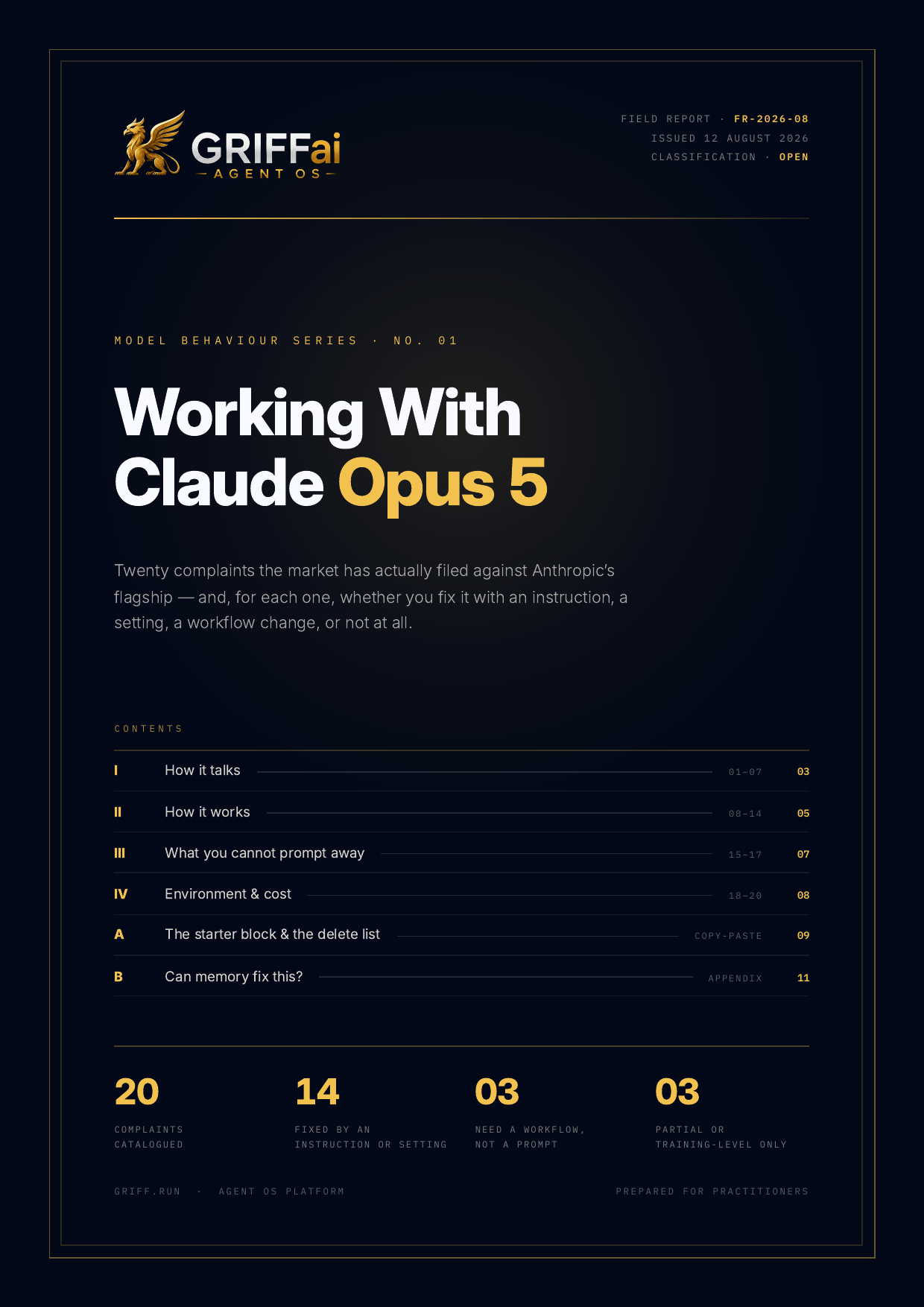
Working with Claude Opus 5.
Twenty complaints the market has actually filed against Anthropic’s flagship — and, for each one, whether you fix it with an instruction, a setting, a workflow change, or not at all. Eleven pages, including a copy-paste starter block and the delete list.
 Read the full report (PDF) →
20
Complaints catalogued
14
Fixed by an instruction or setting
03
Need a workflow, not a prompt
03
Partial or training-level only
Issued 12 August 2026 · Classification: open · Model behaviour series no. 01. Prepared for practitioners running Opus 5 in production.
Download the field report (PDF)Reference library
Topics we cover with every buyer, in writing.
These are the questions procurement teams, security reviewers, and operators ask us most — answered in plain language, organized by who’s asking.
Everyday buyer
What is an AI receipt?
A simple guide to the record every serious AI agent should leave behind: who asked, what happened, what was approved, and what proof remains.
Operations
Why AI agents need a control room
How teams move from scattered chat histories and terminal windows to visible missions, approvals, health, and replay.
Security
Chain of custody for AI agents
How custody records differ from normal logs, why tamper-evidence matters, and what auditors need to verify later.
Managers
Bounded authority for AI work
How to decide which actions agents can take alone and which actions should pause for named human approval.
Developers
Hash chains explained for normal people
A jargon-light explanation of previous hashes, event hashes, and why quiet record changes should be detectable.
Compliance
Preparing for AI audit questions
The plain-language evidence packet a team should be ready to produce when leadership, customers, insurers, or regulators ask what happened.
Platform teams
MCP governance and tool custody
How tool calls, browser actions, files, local runners, and external sends can be routed through a shared custody layer.
Executives
The business case for AI memory infrastructure
How durable records reduce incident response time, audit prep, staff distrust, vendor risk, and AI adoption friction.
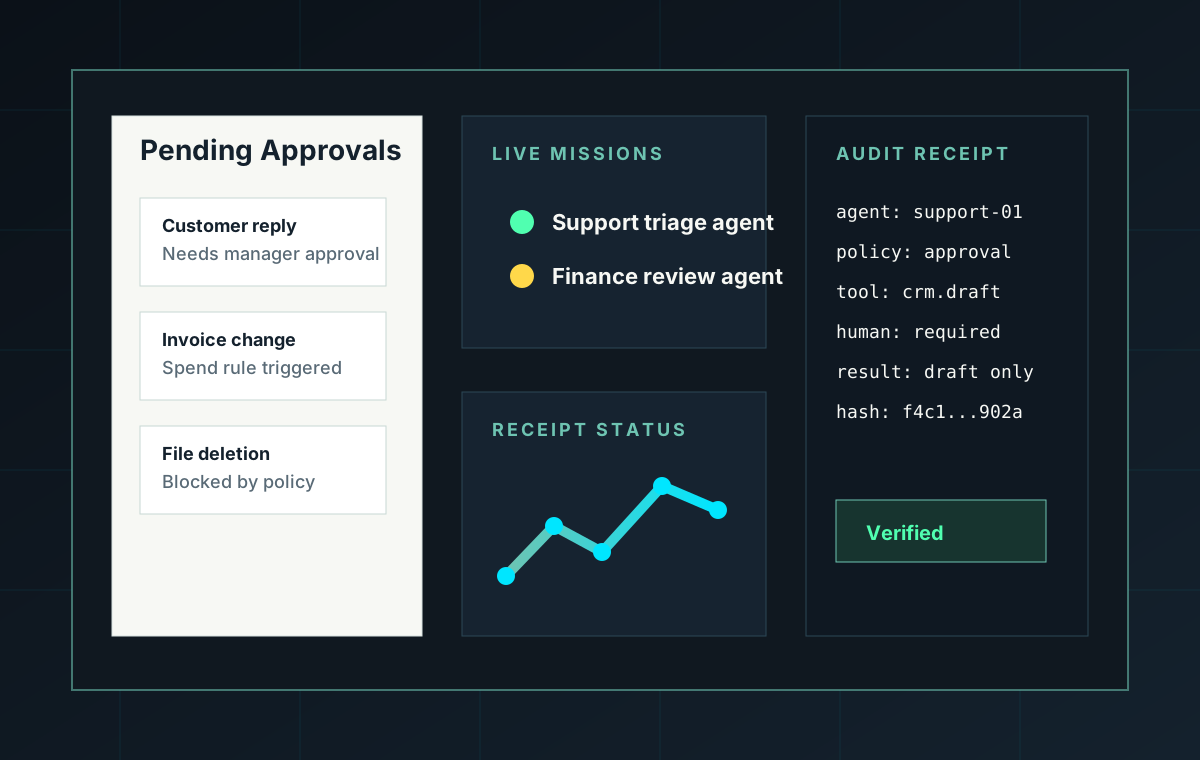
Control room
The buyer sees live missions, policy stops, approval state, and receipts in one workspace.
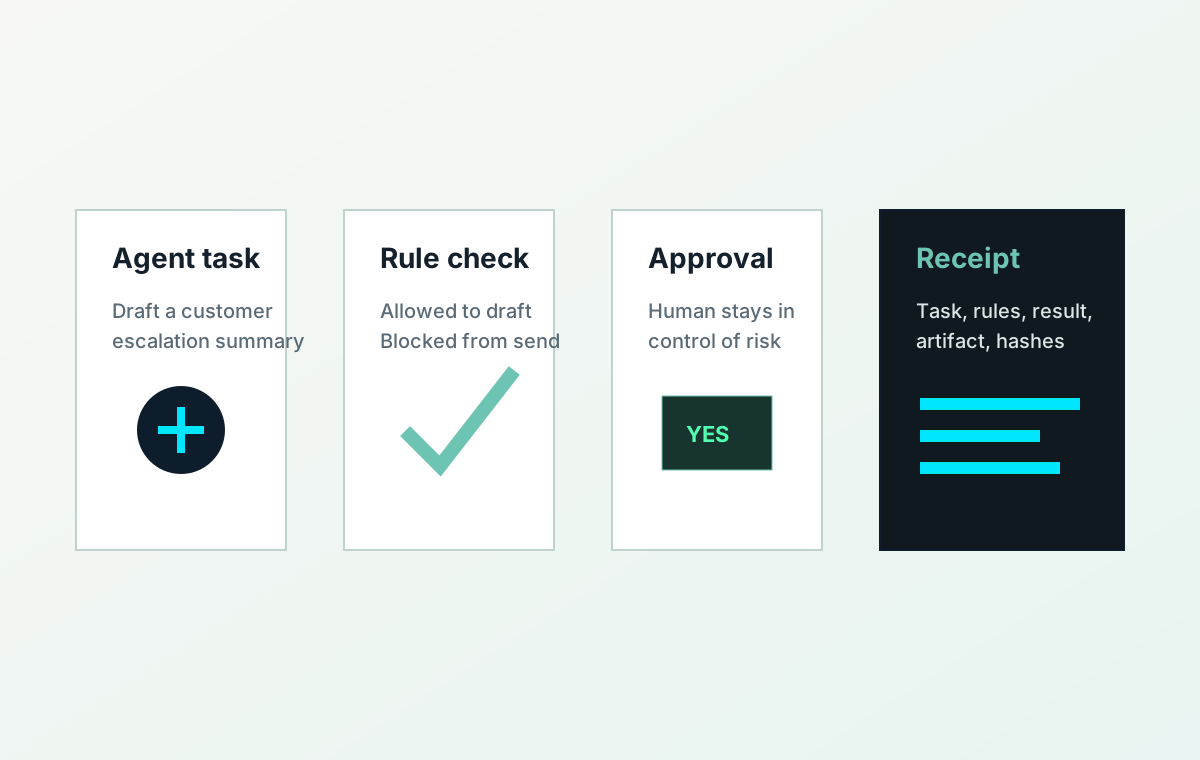
Approval workflow
High-risk AI actions pause for a named human before external send, deletion, billing, or legal commitment.
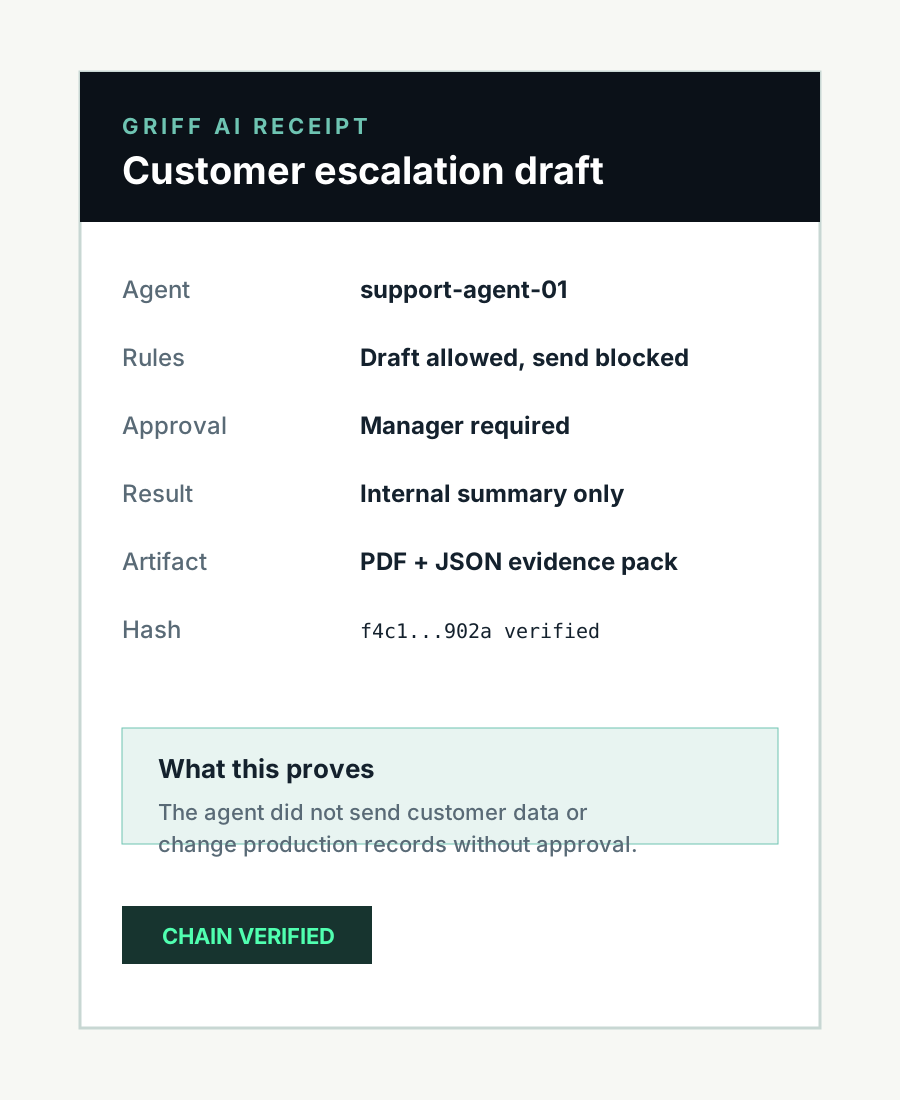
Audit receipt
Each serious action leaves a readable evidence packet backed by hashes, timestamps, policy, and approval.
Trust packet
What a serious buyer should be able to inspect.
We make proof easy to understand before asking anyone to take our word for it. The trust packet combines a readable demo, a real evidence record, our security boundaries, and known limitations stated plainly.
A sample evidence record: prompt, task contract, policy decision, approval, artifact, and the hash chain that ties them together.
A plain-English certificate showing what the agent did and what was blocked.
A security posture summary covering identity, network boundaries, and access control.
Known limitations, stated plainly, with what is planned next.
A reference-call and evidence checklist for procurement teams that need it in writing.